A stroke diagnosis often feels like the start of a frantic race against time. For decades, patients and families have been conditioned to view rehabilitation as a "sprint"—a high-intensity dash to reclaim their old selves before a perceived window of opportunity slams shut. However, the newly released 2026 AHA/ASA Guidelines for Adult Stroke Rehabilitation and Recovery have fundamentally redefined this path.
As a medical science communicator and advocate, I see these guidelines not just as a policy update, but as a paradigm shift. We are moving away from the "window of recovery" myth toward a sophisticated, evidence-based strategy for long-term adaptation. The path to recovery has been fundamentally redefined, and the latest evidence suggests that the most effective journey is often the one that prioritizes precision over speed. Here are seven surprising truths from the new guidelines that every survivor and caregiver needs to know.
1. The "24-Hour Rule" and the Danger of Moving Too Soon
In the "faster is better" culture of modern medicine, the assumption was that getting a patient out of bed immediately after a stroke would jumpstart the brain. The 2026 guidelines offer a crucial, counter-intuitive correction: moving too soon can actually cause neurological worsening.
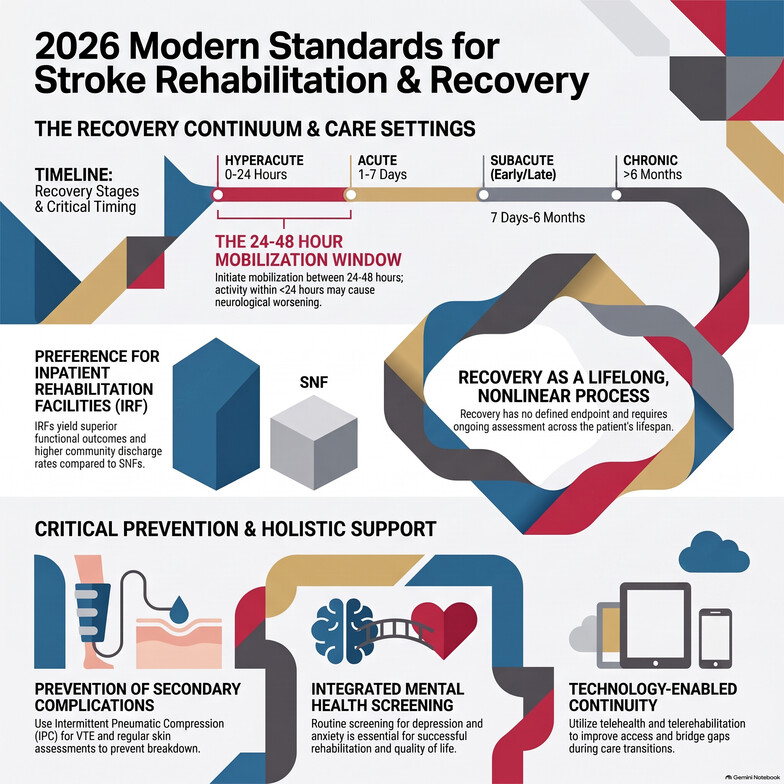
The guidelines now distinguish between "early" mobilization (24–48 hours) and "very early" mobilization (within the first 24 hours). We now know that "high-dose" activity within that first 24-hour window can disrupt cerebral autoregulation—the brain’s delicate ability to maintain steady blood flow despite fluctuating pressures. Pushing for movement in this hyperacute phase can lead to hemodynamic instability, essentially starving vulnerable brain tissue of the oxygen it needs to survive. While movement is medicine, the brain requires a period of metabolic stability before it is ready for the demands of physical exertion.
"After 24 hours poststroke, moderate to high-intensity exercise and task practice should be performed." (Top Take-Home Message 4)
2. The Setting Matters—The "3-Hour Rule" Differentiator
When a survivor is ready to leave the acute hospital, the choice between an Inpatient Rehabilitation Facility (IRF) and a Skilled Nursing Facility (SNF) is one of the most critical decisions a family will make. The 2026 guidelines are unequivocal: treatment in an IRF is the gold standard.
The primary reason is the "3-hour rule." IRFs are required to provide a minimum of 3 hours of therapy, 5 days per week, whereas SNFs (often referred to as "subacute rehab") have no predetermined amount of therapy and less frequent physician oversight. This intensity gap translates to real-world results: patients treated in IRFs show higher rates of community discharge, lower mortality, and significantly better functional improvement. While insurance preauthorization remains a common barrier to access, the evidence confirms that the specialized environment of an IRF is the preferred engine for recovery.
3. Recovery is a Lifelong Journey, Not a Destination
One of the most profound shifts in the new guidelines is the rejection of the idea that recovery stops after a certain timeframe. The medical community now conceptualizes recovery as a "longitudinal process with no defined endpoint."
Instead of a linear path toward "normalcy," recovery is described as a non-linear, dynamic process of adaptation. It is a lifelong cycle where survivors develop new capacities and reconstruct their identities. This shift empowers survivors to seek therapy and adaptation resources years after their initial stroke, acknowledging that the brain’s capacity for change does not have an expiration date.
"Recovery is therefore not a return to a previous self but the development of a resilient new self." (Section 1.0)
4. Mental Health is a Treatable Complication, Not a Side Effect
For too long, post-stroke depression and anxiety were dismissed as "unfortunate side effects." The 2026 guidelines elevate these conditions to a primary clinical priority, classifying them as treatable complications that can actively interfere with physical progress.
Routine, longitudinal screening for both depression and anxiety is now the standard of care. This is an intelligent shift in strategy: treating the mind is as essential for physical recovery as gait training. Depression can significantly compromise the body’s ability to engage in the repetitive tasks required to rewire the brain. By addressing mental health as a clinical target, we remove one of the most significant barriers to successful rehabilitation.
5. The "No-Go" List: Common Tools That May Cause Harm
Progress often requires letting go of outdated traditions. The 2026 guidelines explicitly warn against several "standard" practices that are now considered ineffective or hazardous:
- Overhead Pulley Exercises: Previously a staple for shoulder pain, these are now recommended against. Because of the extreme complexity of the glenohumeral joint and the delicate biomechanics involved in overhead motions, pulley exercises can cause trauma to weakened tissue and worsen shoulder subluxation.
- Elastic Compression Stockings: Once used to prevent blood clots, they are now deemed "not effective" for this purpose in stroke patients. In fact, they carry four times the risk of causing skin breakdown, tissue damage, or tissue death due to reduced blood flow in patients with circulation issues.
6. The Caregiver is Now a Critical Part of the Medical Team
The guidelines now recognize that the "care partner" is not just a support person but a vital component of the clinical team. Crucially, the education of the caregiver is now linked to the survivor’s success. Formal training has been shown to increase caregiver confidence, which reduces secondary injuries for the patient and burnout for the partner.
To ensure safety during transitions of care, the guidelines recommend that caregivers receive formal training in:
- Positioning: Supporting the hemiplegic (weakened) side to prevent pain and contractures.
- Range of Motion (ROM): Safely maintaining joint flexibility.
- Transferring Techniques: The safe mechanics of moving a survivor between beds, chairs, and standing positions.
7. The Telerehabilitation Revolution is Officially Here
Telehealth has graduated from a backup option to a recommended "alternative platform" for driving neuroplasticity. The 2026 guidelines emphasize that technology is the key to providing the high volume of movement necessary to rewire the brain.
Telerehabilitation allows for high-intensity practice within the home environment, facilitating the massive number of repetitions required to trigger neural reorganization. By supporting self-directed practice and easier transitions from the clinic to the home, telerehabilitation makes the necessary "reps" more accessible and cost-effective, ensuring that the work of recovery continues in the place where the survivor actually lives their life.
A Resilient New Self
The 2026 guidelines remind us that the human brain is remarkably resilient, but that resilience requires a lifetime of support, specialized environments, and the courage to move away from outdated practices. Stroke recovery is no longer a race against a closing window; it is a personalized evolution.
If recovery has no official end date, how does that change the way we support the survivors in our lives today?
Reference: