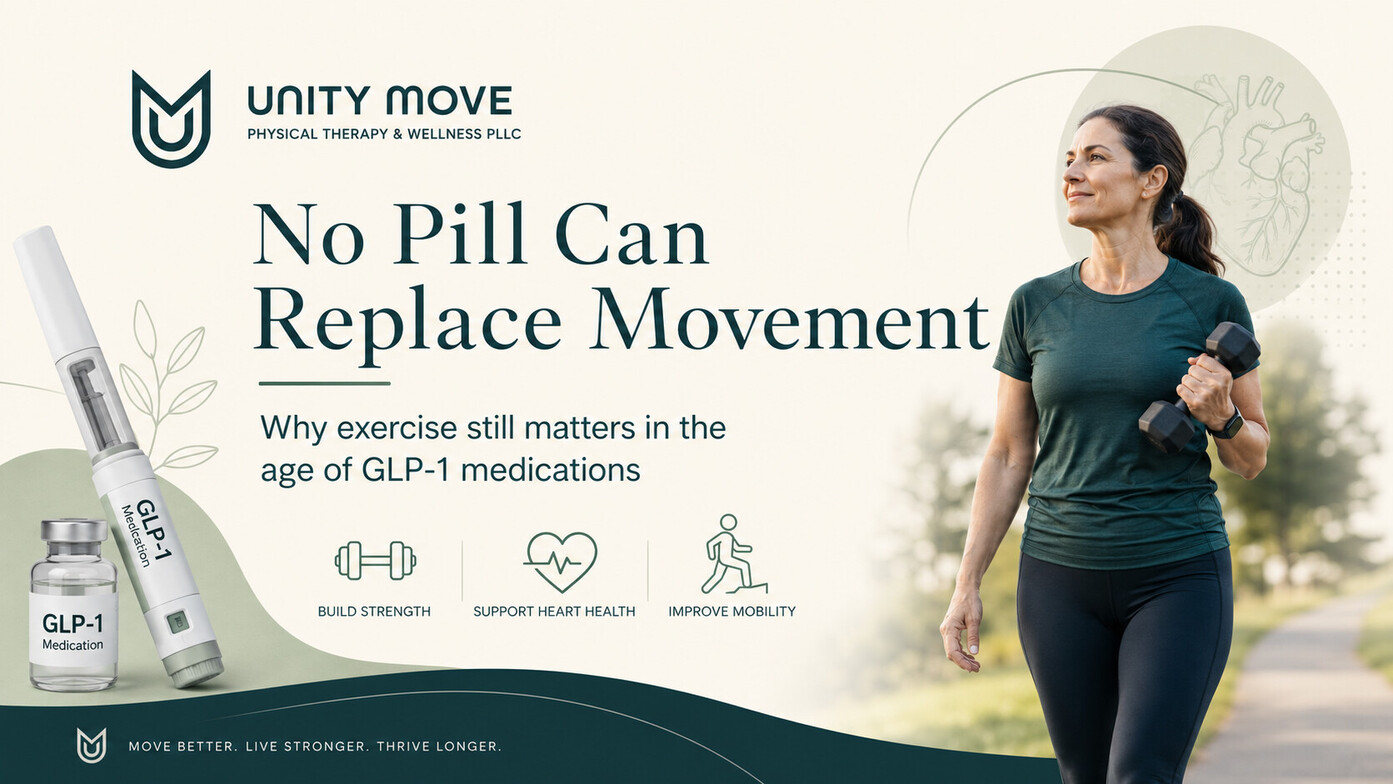
GLP-1 medications have changed the conversation around weight loss. For many people, these medications can reduce hunger, increase fullness, improve blood sugar control, and support meaningful weight loss. They can be an important medical tool.
But they do not replace exercise.
That is the key message from a Harvard FAS Current article featuring evolutionary biologist Daniel Lieberman, who explains that physical activity remains “potent medicine,” especially for people using GLP-1 medications for weight management. GLP-1 medications can affect appetite and body weight, but exercise affects the whole body in ways that a medication cannot fully reproduce. (current.fas.harvard.edu)
GLP-1s Help With Weight Loss, But Weight Loss Is Not the Same as Health
GLP-1 medications work partly by mimicking a gut hormone that helps regulate blood sugar, signals fullness, and reduces hunger. This can lead to reduced food intake and weight loss. For people with obesity, diabetes, or other metabolic concerns, that can be very meaningful. (current.fas.harvard.edu)
However, the number on the scale tells only part of the story.
When people lose weight, they may lose both fat and lean tissue. Lean tissue includes muscle, and muscle is essential for strength, mobility, balance, metabolism, and long-term independence.
This is why exercise matters so much during weight loss.
The Muscle-Loss Concern
One concern raised in the Harvard article is that some of the weight lost while using GLP-1 medications may come from muscle or other lean mass. Lieberman notes that some studies suggest as much as one-third of the weight lost by some GLP-1 users may not be fat, but muscle. (current.fas.harvard.edu)
That matters because muscle is not just about appearance. Muscle is your movement reserve.
Muscle helps you:
Stand up from a chair
Climb stairs
Walk with confidence
Prevent falls
Recover from illness
Maintain independence as you age
For older adults, people with chronic conditions, and anyone trying to improve long-term health, protecting muscle is not optional. It is foundational.
Exercise Does More Than Burn Calories
Many people think of exercise only as a way to burn calories. That is too narrow.
Exercise supports:
- Muscle growth and maintenance
- Heart health
- Metabolism
- Bone health
- Brain health
- Mood
- Balance and coordination
- Daily physical function
The Harvard article emphasizes that exercise activates repair and maintenance processes throughout the body. Lieberman explains that many biological processes are influenced by physical activity, and those broad benefits cannot be fully duplicated by a single medication. (current.fas.harvard.edu)
In other words, GLP-1 medications may help reduce body weight, but exercise helps improve what your body can do.
What Happens After Stopping GLP-1 Medication?
Another important issue is long-term maintenance. Some people stop taking GLP-1 medications due to cost, side effects, access, or personal preference. The Harvard article notes that when people stop these medications, hunger and weight regain can return, and regained weight may come back more as fat than muscle. (current.fas.harvard.edu)
This makes strength training and regular movement even more important.
Exercise can help support long-term weight maintenance, preserve lean mass, and improve body composition. It also provides benefits that go far beyond weight control, including cardiovascular, metabolic, neurological, and functional improvements.
The Best Approach: Medication Plus Movement
The question should not be:
“Should I choose medication or exercise?”
A better question is:
“How can I combine medical care, nutrition, strength training, and daily movement in a safe and sustainable way?”
For many people, GLP-1 medication may be one part of the plan. But movement should remain a core part of the plan, especially strength training.
A smart movement plan may include:
- Progressive resistance training
- Walking or aerobic activity
- Balance exercises
- Mobility work
- Functional strengthening
- Gradual progression based on current ability
- Guidance for pain, injury, or medical conditions
The goal is not simply to lose weight. The goal is to build a body that is stronger, more resilient, and more capable.
Where Physical Therapy Fits In
Physical therapists are movement experts. For people using GLP-1 medications, physical therapy can help build a safe, individualized exercise plan that protects muscle and supports long-term function.
This is especially important for people who:
- Feel weak after weight loss
- Have joint pain or chronic pain
- Are afraid of injury
- Have balance problems
- Have a history of falls
- Are recovering from surgery or illness
- Have neurological conditions such as stroke, Parkinson’s disease, or neuropathy
- Do not know how to start strength training safely
A physical therapist can assess strength, balance, mobility, gait, posture, and functional movement. Then the exercise plan can be matched to the person’s goals and current ability.
The Bottom Line
GLP-1 medications can help with weight loss, but they cannot replace movement.
Weight loss may change the scale.
Exercise changes what your body can do.
If you are using a GLP-1 medication, thinking about starting one, or working on weight management, do not ignore strength, balance, and functional movement. Your future self needs more than a lower number on the scale. Your future self needs muscle, confidence, mobility, and resilience.
At Unity Move Physical Therapy & Wellness, we help people move better, build strength safely, and protect long-term function.
Reframe your movement. Reframe your health.