Shoulder pain from rotator cuff tendinopathy is common, but most cases do not need early MRI or surgery. Learn what the latest clinical practice guideline recommends for diagnosis, rehab, imaging, and return to activity.
Why does my shoulder hurt?
Shoulder pain is one of the most common reasons people seek physical therapy. A frequent cause is rotator cuff tendinopathy, which means the tendons around the shoulder are irritated, painful, or not tolerating load well.
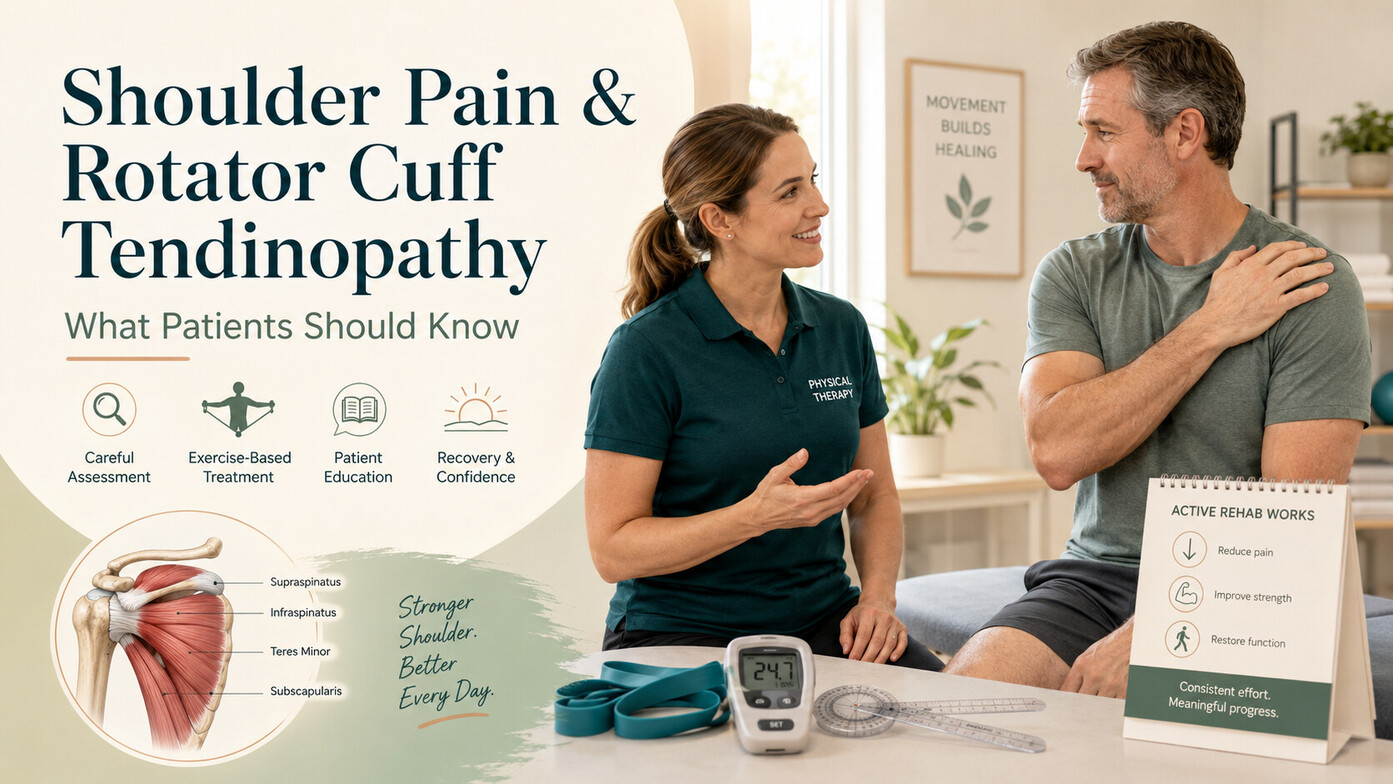
Your rotator cuff is a group of four muscles and tendons that help keep the shoulder joint stable while you lift, reach, push, pull, dress, sleep, exercise, or play sports. The 2025 clinical practice guideline from the Journal of Orthopaedic & Sports Physical Therapy focuses on adults with suspected rotator cuff tendinopathy, including cases with or without calcification and partial-thickness tears.
The big message: start with a good clinical exam
A good shoulder evaluation should not be based only on one test or one image. The guideline recommends that clinicians begin with a detailed history and physical exam.
That means your physical therapist should ask about:
- When and how the pain started
- What movements make it worse or better
- Your work, sports, hobbies, and daily activities
- Sleep problems related to shoulder pain
- Loss of motion or strength
- Neck pain, numbness, tingling, or neurological symptoms
- Previous imaging, treatments, or injections
- Your goals for recovery
The physical exam should include observation of the shoulder, active and passive range of motion, strength testing, and screening for other possible causes of pain. The guideline also emphasizes checking for “red flags,” such as fever, suspicious deformity, signs of systemic illness, cardiovascular or visceral symptoms, or history/suspicion of cancer.
Do I need an MRI right away?
In many cases, no.
One of the most important patient-friendly takeaways is this: the guideline recommends not using diagnostic imaging just to confirm rotator cuff tendinopathy during initial management. Imaging may be considered if symptoms do not improve after up to 12 weeks of appropriate nonsurgical care. When imaging is needed, diagnostic ultrasound is often prioritized because it costs less and has diagnostic properties similar to MRI for confirming many rotator cuff disorders.
This matters because imaging findings do not always match symptoms. Many people have tendon changes on imaging even when they have little or no pain. A scan can be useful in the right situation, but it should not replace a careful clinical exam.
What should be measured during physical therapy?
The guideline strongly supports using objective measures instead of guessing.
For shoulder motion, clinicians should use tools such as a goniometer, inclinometer, or smartphone-based inclinometer/goniometer app rather than visual estimation. For strength, clinicians should use a handheld dynamometer to objectively measure shoulder muscle force. The guideline also recommends using validated patient-reported questionnaires to track pain and disability over time.
In practical terms, this means your care should include answers to questions like:
“How much motion do I have?”
“How strong is my painful side compared with the other side?”
“Is my pain and function improving over time?”
“Am I ready to return to work, exercise, or sport?”
At Unity Move Physical Therapy & Wellness, this type of objective measurement fits our approach: we want patients to see their progress, not just feel uncertain about it.
What treatment works best?
The guideline recommends an active rehabilitation exercise program as an initial treatment to reduce pain and disability in adults with rotator cuff tendinopathy. This may include motor control exercises, resistance training, and progressive loading.
A good rehab program is not simply a list of generic shoulder exercises. It should be individualized based on your pain level, strength, movement limitations, daily demands, and goals.
Common components may include:
- Gentle mobility work
- Rotator cuff and scapular strengthening
- Progressive resistance training
- Motor control and coordination exercises
- Gradual exposure to reaching, lifting, pushing, pulling, or overhead tasks
- Education on activity modification and self-management
The goal is not just to “rest the shoulder.” The goal is to help the shoulder tolerate load again.
What about manual therapy, taping, injections, or other treatments?
Some treatments may help in selected cases, but they should not replace active rehab.
The guideline states that manual therapy may be used alone or with exercise to help reduce pain in the short term. Taping may also be used with an active rehabilitation program for short-term pain reduction. Patient-centered education is also recommended, including information about the condition, pain management, activity modification, and self-management.
For medication and injections, the guideline notes that acetaminophen or oral NSAIDs may reduce pain in the short term. Corticosteroid injections may reduce short-term pain and disability, but they are not recommended as first-line treatment. Opioids should not be used as a first-line option and require careful reassessment if prescribed.
What treatments are not strongly recommended?
The guideline makes several important distinctions.
For noncalcific rotator cuff tendinopathy, extracorporeal shockwave therapy is not recommended to reduce pain and disability. For calcific rotator cuff tendinopathy, shockwave therapy may be used. Therapeutic ultrasound is not recommended as a stand-alone treatment or as an add-on to active rehab for either calcific or noncalcific rotator cuff tendinopathy.
This does not mean every modality is “bad.” It means the best-supported foundation is still education, progressive exercise, objective measurement, and individualized care.
When should I be referred to a specialist?
The guideline recommends referral to a musculoskeletal physician specialist, such as a sports medicine physician, physiatrist, or orthopedic surgeon, when severe and persistent pain or disability remains despite up to 12 weeks of appropriate nonsurgical care.
This does not mean surgery is automatically needed. It means further assessment may be appropriate if the shoulder is not responding as expected.
Returning to sport, exercise, or work
Return to activity should be based on more than time. The guideline recommends considering the athlete’s shoulder capacity, load tolerance, pain, disability, readiness, and functional performance measures. Return-to-sport decisions should also consider the entire kinetic chain, including trunk, pelvis, and lower extremity function when relevant.
For patients, this means the question is not only:
“Has enough time passed?”
A better question is:
“Can my shoulder handle the demands I am returning to?”
That may include lifting, carrying, reaching overhead, throwing, swimming, racquet sports, gym training, work tasks, or caring for family members.
Bottom line
Rotator cuff tendinopathy is common and treatable. The latest guideline supports a practical, evidence-based approach:
- Start with a thorough clinical exam.
- Avoid unnecessary early imaging.
- Measure motion, strength, pain, and function objectively.
- Use active rehabilitation as the foundation of care.
- Add manual therapy, taping, medication, or injections only when appropriate.
- Progress back to work, exercise, and sport based on capacity—not guesswork.
At Unity Move Physical Therapy & Wellness, our goal is to help you understand your shoulder, rebuild confidence, and return to the activities that matter most to you.
Reference: Desmeules F, Roy J-S, Lafrance S, et al. Rotator Cuff Tendinopathy Diagnosis, Nonsurgical Medical Care, and Rehabilitation: A Clinical Practice Guideline. J Orthop Sports Phys Ther. 2025;55(4):235-274.