Standing in a modern grocery store aisle often feels like navigating a theater of conflicting claims.
One label promises that a specific fat is a "superfood," while the next warns that it is a hidden cardiovascular poison. The 2026 American Heart Association (AHA) Scientific Statement emerges not just as a set of rules, but as a long-overdue corrective to this national confusion, serving as a definitive "North Star" for the modern plate.
This landmark update signals a profound paradigm shift in nutritional science, moving the focus away from the search for "miracle" ingredients. We are no longer being told to hunt for a single nutrient to save us. Instead, the guidelines emphasize "dietary patterns"—the cumulative narrative of everything we eat and drink over time.
Stop Obsessing Over Nutrients, Start Focusing on Patterns
Heart health is not the result of a high-stakes calculation involving a single ingredient or a temporary "detox." The AHA now emphasizes that our cardiovascular wellness is determined by the totality of what we consume throughout the day. This shift recognizes that the body responds to a symphony of nutrients rather than an isolated soloist, even leading to favorable modulation of the gut microbiota.
This pattern-based approach is a victory for inclusivity, moving away from rigid, one-size-fits-all diets. By prioritizing a broad style of eating over a restricted list of "allowed" foods, the guidelines allow for deep cultural and personal flexibility. This ensures that heart health is a reachable goal for every life stage and background.
Food-based dietary pattern guidance is designed to achieve nutrient adequacy; to support cardiovascular health and general well-being; and to provide flexibility to accommodate personal preferences, ethnic and religious practices, and life stages.
The "Health Food" Myth of Tropical Oils and Solid Fats
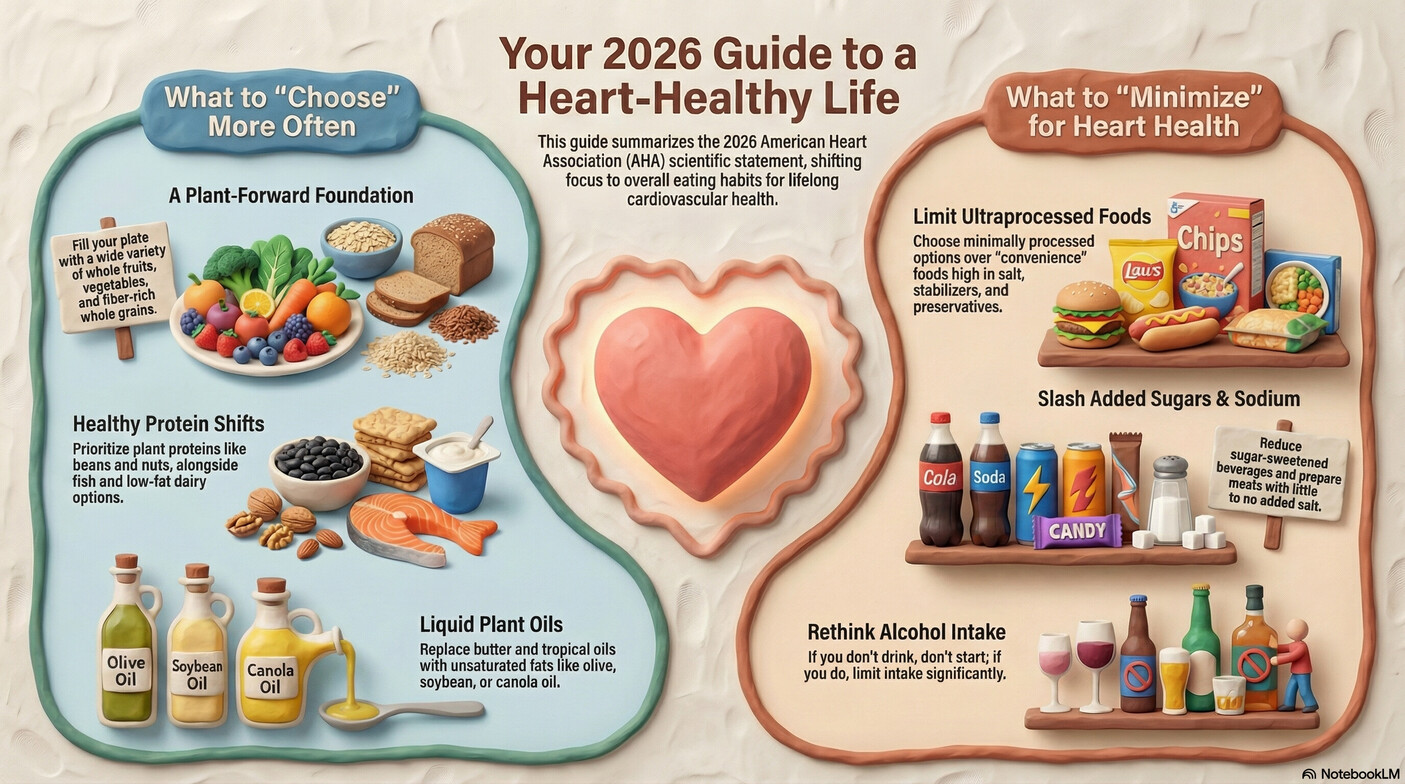
In recent years, "health halos" have been placed on certain fats that the 2026 guidelines now firmly deconstruct. The AHA makes a sharp, evidence-based distinction between liquid plant oils and "solid" fats. Despite popular trends, tropical oils—specifically coconut, palm, and cocoa butter—are identified as significant sources of saturated fat that can compromise arterial health.
To optimize the heart's longevity, these tropical options, along with animal fats like butter, lard, and beef tallow, should be replaced with liquid nontropical plant oils. Transitioning to soybean, canola, or olive oils has been proven to lower low-density lipoprotein (LDL) cholesterol. This finding is a critical reality check for anyone led to believe that coconut oil was a superior alternative to traditional heart-healthy oils.
Your Freezer and Pantry are Secret Weapons
The perceived barrier to a heart-healthy life is often the high cost and rapid spoilage of "organic" fresh produce. The AHA dismantles this barrier by highlighting the freezer and pantry as valid tools for cardiovascular protection. Whole or minimally processed vegetables and fruits remain the core of the recommended pattern, regardless of their storage method.
Frozen and canned varieties are essentially "preserved vitality," provided they lack added sugars or sodium. This guidance significantly lowers the barrier to entry, addressing common concerns about food waste and expense. It empowers the reader to build a "resilient kitchen" that supports heart health even when fresh options are out of reach.
The Alcohol Protection Theory is Under Fire
For decades, the notion that a daily glass of wine protects the heart was a staple of wellness culture. The 2026 guidelines take a much more cautious stance based on "Mendelian randomization" studies—a sophisticated method using genetic data to filter out lifestyle noise and mimic a clinical trial. This new research suggests that previous "protective" associations were likely influenced by other lifestyle factors.
The evidence now shows that the relationship between alcohol and blood pressure is linear and progressive, meaning risk increases even at low levels of consumption. Consequently, the AHA has issued a precise new directive: if you do not currently drink, do not start. For those who do consume alcohol, the mandate is clear—limit intake to mitigate risk.
Initiation of alcohol intake at any level to improve cardiovascular health is not recommended given the uncertainty about net health effects and especially considering the deleterious effects of alcohol on numerous other outcomes.
The "Prenatal to Age One" Rule and the Life Course
Heart health is no longer a conversation reserved for the middle-aged; it is a "Life Course" trajectory that begins even before birth. The 2026 guidelines emphasize that the relevance of diet starts in the prenatal period and becomes foundational by age one. Establishing these habits early is essential to preventing the development of Cardiovascular-Kidney Metabolic (CKM) syndrome later in life.
Because dietary patterns are often transmitted among household members, heart health is essentially a shared family legacy. Adults act as the primary role models, influencing the dietary trajectories of the next generation. By prioritizing these habits now, we encourage a favorable intergenerational transmission of lifestyle behaviors that can protect a family for decades.
A Blueprint for Long-Term Vitality
The 2026 guidelines offer a comprehensive blueprint that extends its benefits far beyond the arteries. The recommended dietary patterns are remarkably consistent with the protocols for preventing type 2 diabetes, certain cancers, and cognitive decline. This alignment suggests that what is good for the heart is fundamentally good for the entire human system.
Ultimately, these findings encourage us to look at the broad horizon of our lives rather than the immediate gratification of a single meal. If heart health isn't about the next 30 days, but the next 30 years, how does that change what you choose to put on your plate today?