A stroke doesn’t knock; it breaks the door down. One moment you are pouring coffee or mid-sentence; the next, the world is tilting on its axis. It is a medical ambush that strikes with terrifying speed, where the trajectory of a life is decided in a handful of heartbeats. When a stroke occurs, the clock becomes a relentless enemy. Every second dictates the future, drawing the thin line between a full recovery and permanent disability. Because the brain cannot wait, your only defense is a state of absolute readiness.
Beyond the Basics: The Critical Importance of 'B' and 'E'
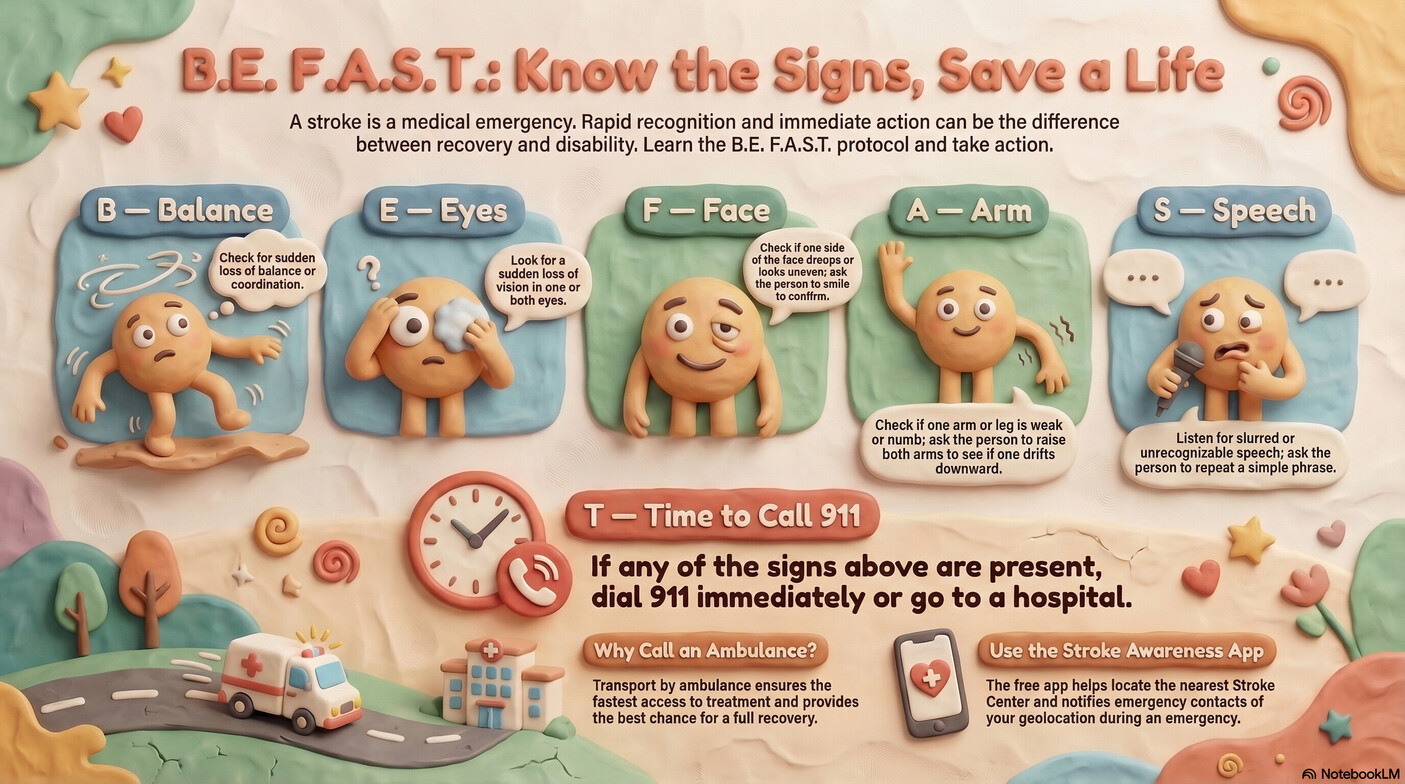
Most of us can spot a classic stroke symptom, but the modern protocol—B.E. F.A.S.T.—demands we look closer at two often-ignored red flags: Balance and Eyes.
- Balance: A sudden, unexplained loss of coordination or a feeling of being "off-kilter."
- Eyes: A sudden loss of vision in one or both eyes, or a terrifying "gray-out."
Why do we so often ignore these? It comes down to the nature of the cue. While a drooping face is a "social" sign that others can see, balance and vision are "internal" disruptions. We tend to dismiss them as simple vertigo or eye strain, hoping to "wait it out" until the feeling passes. In a stroke emergency, waiting is the one thing you cannot afford. These aren't just inconveniences; they are the narrow window of opportunity to save a life before the damage becomes permanent.
The Simple Tests: Face, Arm, and Speech
When a stroke is suspected, you must transition from bystander to first responder. These three physical "stress tests" provide immediate clarity when panic sets in, revealing neurological deficits that the victim may not even realize they are experiencing:
- Face: Ask the person to smile. Does one side of the face droop or look uneven?
- Arm: Ask the person to raise both arms. Does one arm or leg feel weak or numb? Look for one arm drifting downward.
- Speech: Ask the person to repeat a simple phrase. Is the speech slurred, garbled, or entirely unrecognizable?
These tests move you past uncertainty. If any of these actions fail, the diagnosis is clear: the clock is ticking.
The Ambulance Advantage: Why You Shouldn't Drive Yourself
If you identify even one sign, the instruction is absolute: dial 911 immediately. Do not grab your keys. Do not attempt to drive yourself or a loved one to the hospital.
"Transport by ambulance ensures the fastest access to treatment and the best chance for recovery. Activating EMS is the most critical step to improving stroke outcomes."
The "Ambulance Advantage" is about "pre-loading" the medical response. Emergency Medical Services (EMS) don't just provide a ride; they provide a head start. While en route, they communicate directly with a Stroke Certified Hospital or Stroke Center. This ensures that the specialized medical team is prepped and the imaging equipment is cleared before you even roll through the doors. Driving yourself often means losing precious minutes in a standard emergency room waiting area—minutes where brain cells are dying.
High-Tech Survival: The App in Your Pocket
In a crisis, technology is your digital safety net. The Stroke Awareness Foundation app is designed to bridge the gap when a victim is physically unable to communicate.
One of the most devastating symptoms of a stroke is aphasia—the loss of the ability to speak or understand language. When your words fail, the app speaks for you. Key features include:
- Emergency Notifications: Instantly sends your geolocation to emergency contacts to let them know exactly where you are and that you are having a stroke.
- Stroke Center Locator: Instantly identifies the nearest Stroke Center, ensuring you reach a facility equipped to handle the emergency.
- Symptom Reference: Provides an "on the spot" guide to the B.E. F.A.S.T. signs.
- Multilingual Support: Vital resources are accessible in English, Español (Spanish), 中文 (Chinese), 한국어 (Korean) and Quốc ngữ (Vietnamese).
Conclusion: A Community of Readiness
Stroke awareness is more than a personal health goal; it is a shared community responsibility. This mission of readiness is championed by a diverse coalition of leaders. These leaders recognize that survival depends on a community that knows how to act.
Readiness is a choice made long before the emergency starts. The transition from victim to survivor often depends entirely on the person standing next to them. If the clock started ticking right now, would you know exactly what to do?