For years, the face of Carpal Tunnel Syndrome (CTS) has been the office worker—the accountant or programmer whose hands are weary from a day of clicking mice and rapid-fire typing.
We spend billions on ergonomic keyboards and vertical mice, yet the persistent tingle and ache in our wrists remain. Why?
According to the newly released 2026 Clinical Practice Guidelines from the American Physical Therapy Association (APTA), the answer is that much of our popular wisdom about CTS is outdated. The weight of this diagnosis isn't just felt in the nerves of the hand, but in the profound stress of the workday and the fear of losing one's livelihood. These new guidelines shift our understanding from a simple "pinched nerve" to a complex, chronic condition involving inflammation, industrial labor, and even mental health.
Here are the six most impactful takeaways from the 2026 guidelines that redefine how we identify and treat this condition.
1. The "Office Worker" Myth
The most persistent stereotype about CTS is that it is an "office worker’s disease." However, the 2026 guidelines provide "moderate evidence supporting no increase in risk" for those whose primary task is computer work.
The real risk lies in manual labor. Modern data shows that laborers—particularly those in the food processing and manufacturing industries—experience a fivefold higher incidence of CTS than clerical workers. The strongest occupational risk factor isn't the repetitive motion of typing, but "forceful hand exertions." This discovery shifts the responsibility of prevention from IT departments to industrial safety. To truly turn the tide on CTS, we must focus on high-load manual environments where workers’ hands are their primary tools for survival.
2. Why Your "Healing Magnet" Doesn't Work
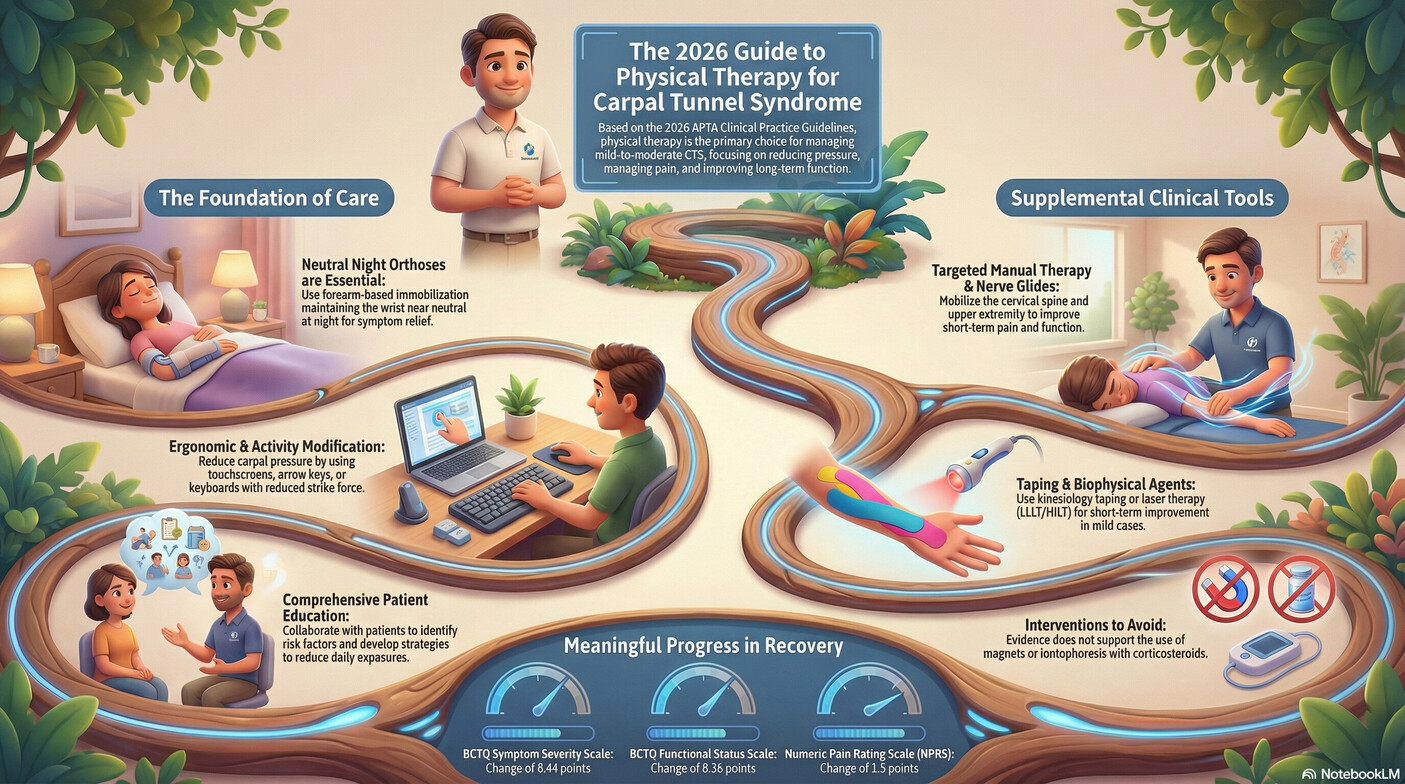
The wellness market is saturated with "snake oil" treatments, from magnetic bracelets to specialized electrical patches. The APTA guidelines take a decisive stand against these popular but ineffective interventions using a rigorous evidence-grading system.
The guidelines issued a Grade B recommendation against magnets, but even more significant is the Grade A recommendation—the strongest level of evidence—against iontophoresis (the use of electric current to deliver steroids through the skin). In clinical terms, a Grade A recommendation means the evidence is so clear that clinicians must not or should not use this method.
Guideline Recommendation: "Clinicians should not use or recommend the use of magnets for the management of CTS."
Just because a treatment is popular doesn't mean it has "Absolute Grounding" in science. By stripping away these ineffective gadgets, patients can focus on treatments that actually work.
3. The Power of the "CTS-6" Battery
For decades, diagnosis relied on single "magic" tests, like the Phalen test (folding hands together) or the Tinel sign (tapping the wrist). We now know that no single test is definitive. In fact, the 2026 guidelines have officially discredited the once-popular "Scratch Collapse Test" as invalid.
Instead, the gold standard is now the "CTS-6" battery. This is a holistic look at six specific factors:
- Numbness in the thumb, index, and middle fingers.
- Symptoms that worsen at night.
- Thenar muscle atrophy (visible wasting of the muscle at the base of the thumb).
- A positive Phalen test.
- A positive Tinel sign.
- Diminished "two-point discrimination" (the ability to feel two distinct points on the skin).
This shift brings clinical precision to your diagnosis: a total score of 12 on the CTS-6 is associated with an 80% probability of CTS.
4. The Night Shift: Why "Neutral" Splinting is Non-Negotiable
The most effective nonsurgical treatment is often the simplest: a wrist splint. However, it must be the right kind. The guidelines recommend a forearm-based immobilization orthosis that maintains the wrist at a 0° neutral position in the sagittal plane (meaning the wrist is straight, not bent up or down).
This position maximizes the space inside the carpal tunnel, allowing "intraneural edema" (swelling inside the nerve itself) to recede.
Guideline Recommendation: "Clinicians should recommend a forearm-based, wrist immobilization orthosis, confirming that it maintains the wrist near neutral in the sagittal plane, worn at night for short- and/or mid-term improvement."
While it may seem counter-intuitive that resting at night fixes a daytime problem, this neutral positioning prevents the "fibrosis"—a type of internal scarring and thickening—that characterizes chronic CTS.
5. It’s Not All in the Wrist: The Mental Health Connection
Perhaps the most "intellectually stimulating" shift in the 2026 revision is the link between the mind and the hand. Research shows that approximately 30% of CTS patients experience anxiety or depression.
This isn't just a side effect; it's a predictor. The guidelines highlight "pain catastrophizing"—the tendency to assume the worst about one's pain—as a major factor that can predict surgical success more accurately than physical tests. Managing the brain’s response to pain and reducing "pain-related worry" is now seen as just as vital as physical therapy. CTS is a whole-person condition, and ignoring the mental weight of hand pain often leads to poorer long-term outcomes.
6. New Tech: Sound Waves to Wake Up a Nerve
The guidelines introduce a modern intervention that sounds like something out of a sci-fi novel: Extracorporeal Shockwave Therapy (ESWT). This involves using acoustic pressure waves to jump-start the body’s healing response.
The 2026 guidelines specifically suggest that clinicians consider Radial ESWT (rESWT) over focused versions for short-to-mid-term relief. Rather than using heat, these mechanical waves stimulate blood flow and anti-inflammatory mediators. Essentially, we are using sound to "wake up" a nerve that has been compressed into a state of low-grade inflammation and fibrosis.
Conclusion: A Forward-Looking Summary
The 2026 guidelines make one thing clear: we cannot rely on "gut feelings" or ergonomic gimmicks to treat Carpal Tunnel Syndrome. Effective management requires a combination of industrial-level risk assessment, clinical precision through the CTS-6, proper neutral splinting, and a deep respect for the mind-body connection.
If we start treating our mental health and physical rest as seriously as our ergonomic keyboards, could we finally turn the tide on chronic hand pain?