Technology is changing many parts of healthcare, including physical therapy. Artificial intelligence, wearable sensors, computer-based movement analysis, and rehabilitation robots are increasingly being used to help people improve their movement and independence.
These technologies may sound futuristic, but their purpose is straightforward: to help patients practice more effectively and give therapists better information about how a person is moving.
However, AI and robots do not replace physical therapists. The best results occur when technology is combined with skilled, personalized, and compassionate care.
What Is Artificial Intelligence in Rehabilitation?
Artificial intelligence, usually called AI, refers to computer systems that can analyze information and identify patterns. In rehabilitation, AI may examine movement data from a camera, sensor, exercise device, or wearable technology.
For example, an AI-supported system may help measure:
-
Walking speed
-
Step length
-
Balance and body sway
-
Joint movement
-
Differences between the right and left sides
-
Sit-to-stand performance
-
Exercise repetitions
-
Changes in movement over time
Instead of relying only on observation, a therapist may use these measurements to better understand a patient’s movement and track progress.
AI is also being explored for home exercise monitoring, virtual rehabilitation, patient education, and clinical documentation. Research on AI-supported rehabilitation continues to grow, particularly in areas such as stroke rehabilitation, walking analysis, wearable sensors, and remote care. Rehabilitation Robot?
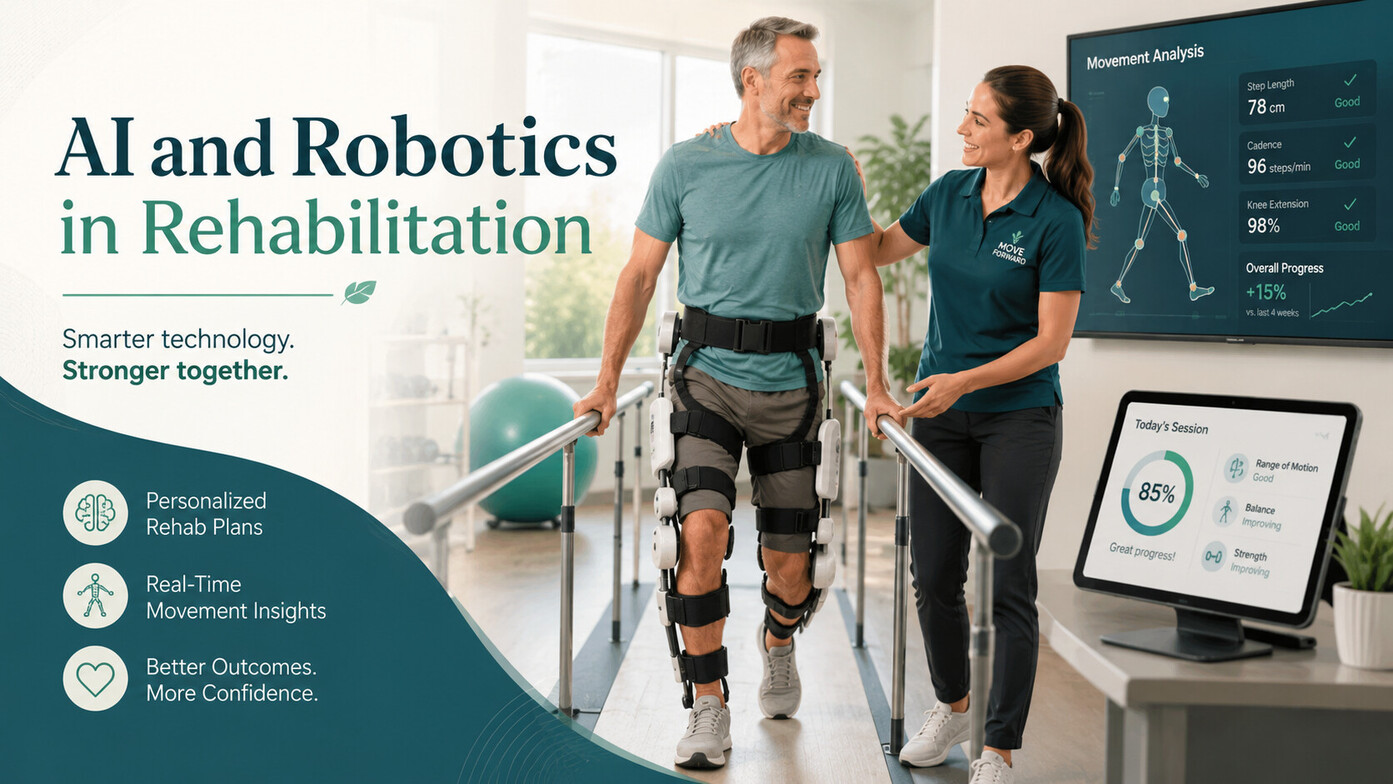
A rehabilitation robot is a device that helps a person practice a specific movement. Some robots support the arms or hands, while others assist the legs, hips, or walking pattern.
Common examples include:
-
Robotic walking devices: Help support the legs or hips during walking practice
-
Robotic exoskeletons: Wearable devices that assist movement at one or more joints
-
Robotic arm devices: Guide or support reaching and arm movements
-
Robotic gloves: Help people practice opening and closing the hand
-
Interactive exercise systems: Combine robotics with games or visual feedback
The robot may provide more assistance when a movement is difficult and reduce that assistance as the patient improves.
How Can These Technologies Help?
1. Providing More Repetition
Recovery often requires practicing a movement many times. A robotic device may help a patient safely complete repeated steps, reaches, or hand movements.
This can be especially helpful when weakness, fatigue, poor coordination, or balance problems make repeated practice difficult.
2. Giving Accurate and Detailed Feedback
Some systems show patients how they are moving in real time. A patient may see whether they are placing equal weight on both legs, taking similar steps, bending a joint correctly, or completing an exercise at the intended speed.
Accurate and detailed feedback can help patients better understand their movement and participate actively in their rehabilitation.
3. Measuring Small Changes
Recovery does not always happen in large, obvious steps. AI-based movement analysis may detect changes that are difficult to see with the eyes alone.
For example, a patient’s walking speed may remain similar while their step symmetry, balance, or movement control improves. Objective measurements can help the therapist identify these changes and adjust the treatment plan.
4. Adjusting the Level of Assistance
Some robotic systems can change how much help they provide based on the patient’s performance. The device may provide more support when needed and less support as the patient gains strength or control.
The goal is not for the robot to do the movement for the patient. The goal is to help the patient remain actively involved while practicing safely.
5. Making Exercise More Engaging
Technology-supported exercises may include games, visual targets, scores, or progress reports. These features can make repetitive exercises more interesting and motivating.
Who May Benefit?
AI-supported assessment and robotic rehabilitation may be considered for people with:
-
Stroke
-
Parkinson’s disease
-
Multiple sclerosis
-
Spinal cord injury
-
Traumatic brain injury
-
Balance or walking difficulties
-
Arm or hand weakness
-
Orthopedic injuries or surgery
-
Age-related changes in strength and mobility
The technology must match the person’s goals, abilities, medical condition, and stage of recovery. A device that is useful for one patient may not be appropriate for another.
What Does the Research Show?
Research suggests that robot-assisted therapy can support improvements in movement, walking, balance, and arm function for some patients, particularly when it is combined with conventional rehabilitation.
However, the findings are not the same across every study. Some studies have found measurable improvements that were too small to represent a meaningful change in daily life. The type of device, amount of practice, patient characteristics, treatment intensity, and involvement of the therapist may all affect the results. A robot should not be viewed as a guaranteed or stand-alone treatment. It is one tool that may be included within a broader rehabilitation program.
Can AI or a Robot Replace a Physical Therapist?
No. Technology can collect data, provide assistance, and support exercise, but it cannot fully understand a patient’s needs.
A physical therapist must still:
-
Determine why a movement problem is occurring
-
Identify safety concerns
-
Select appropriate exercises
-
Adjust treatment based on symptoms and goals
-
Consider the patient’s home and community environment
-
Connect improvements in the clinic to meaningful daily activities
-
Provide encouragement, education, and hands-on care when needed
Professional organizations support the responsible use of AI when it improves patient care, protects patient interests, and supports rather than replaces clinical decision-making. Risks or Limitations?
AI and rehabilitation robots have important limitations.
A computer system may produce inaccurate measurements when the camera view is blocked, lighting is poor, movement is unusual, or the software has not been adequately tested for a particular population.
Other considerations include:
-
Patient comfort
-
Fall risk
-
Skin irritation from wearable equipment
-
Fatigue or pain during repeated exercise
-
Cost and availability
-
Protection of video and health information
-
Whether the technology has been properly validated
-
Whether the device supports the patient’s actual functional goals
Healthcare organizations emphasize that AI should be used with appropriate oversight, privacy protection, transparency, and attention to possible errors or bias. What would patients ask?
Before beginning technology-assisted rehabilitation, consider asking:
-
What is this device measuring or assisting?
-
How does it relate to my personal goals?
-
Will I still be actively performing the movement?
-
How will my therapist use the information?
-
How is my personal information protected?
-
How will we know whether the treatment is helping?
-
Will the activity improve something I need to do at home or in the community?
Clear answers can help patients make informed decisions and understand the role of technology in their care.
The Unity Move Approach
At Unity Move Physical Therapy Wellness PLLC, technology is used to support—not replace—individualized physical therapy.
Our focus remains on the person, not the device. When technology is appropriate, objective movement measurements and rehabilitation equipment can help us better understand how you move, monitor meaningful changes, and select activities that address your goals.
The most advanced technology is valuable only when it helps you do something meaningful: walk more safely, improve your balance, use your arm more effectively, return to an activity, or participate more fully in everyday life.
Human-guided care and thoughtfully selected technology can work together to help you move with greater confidence.
References
-
World Health Organization. Rehabilitation. Rehabilitation is intended to optimize functioning and reduce disability. sical Therapy Association. Ethical and Effective Integration of Artificial Intelligence Across Physical Therapist Practice, Education, and Research. al. Artificial Intelligence in Physical Rehabilitation: A Systematic Review. l. Efficacy of Robot-Assisted Training on Upper-Limb Motor Function After Stroke. Robot-Assisted Therapy for Upper-Limb Rehabilitation After Stroke: Systematic Review and Meta-Analysis.*