Introduction: More Than Just High Kicks
When you picture Taekwondo, you likely imagine young athletes executing sharp, powerful kicks and acrobatic spins. It's a martial art known for its high energy and incredible physical discipline. But what if its core principles could be adapted for a completely different group?
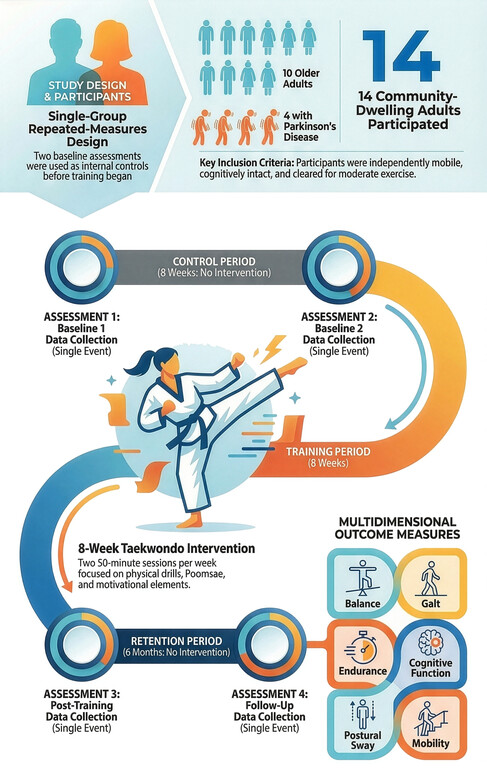
A recent pilot study conducted by Dr. Bokkyu Kim and his team at SUNY Upstate Medical University has uncovered surprising and significant benefits of a modified Taekwondo program for community-dwelling older adults and individuals with mild to moderate Parkinson's disease. This research reveals that the ancient martial art offers far more than just physical conditioning. Here are the five most impactful and unexpected findings from this study.
1. A Surprising Speed Boost for Parkinson's Participants
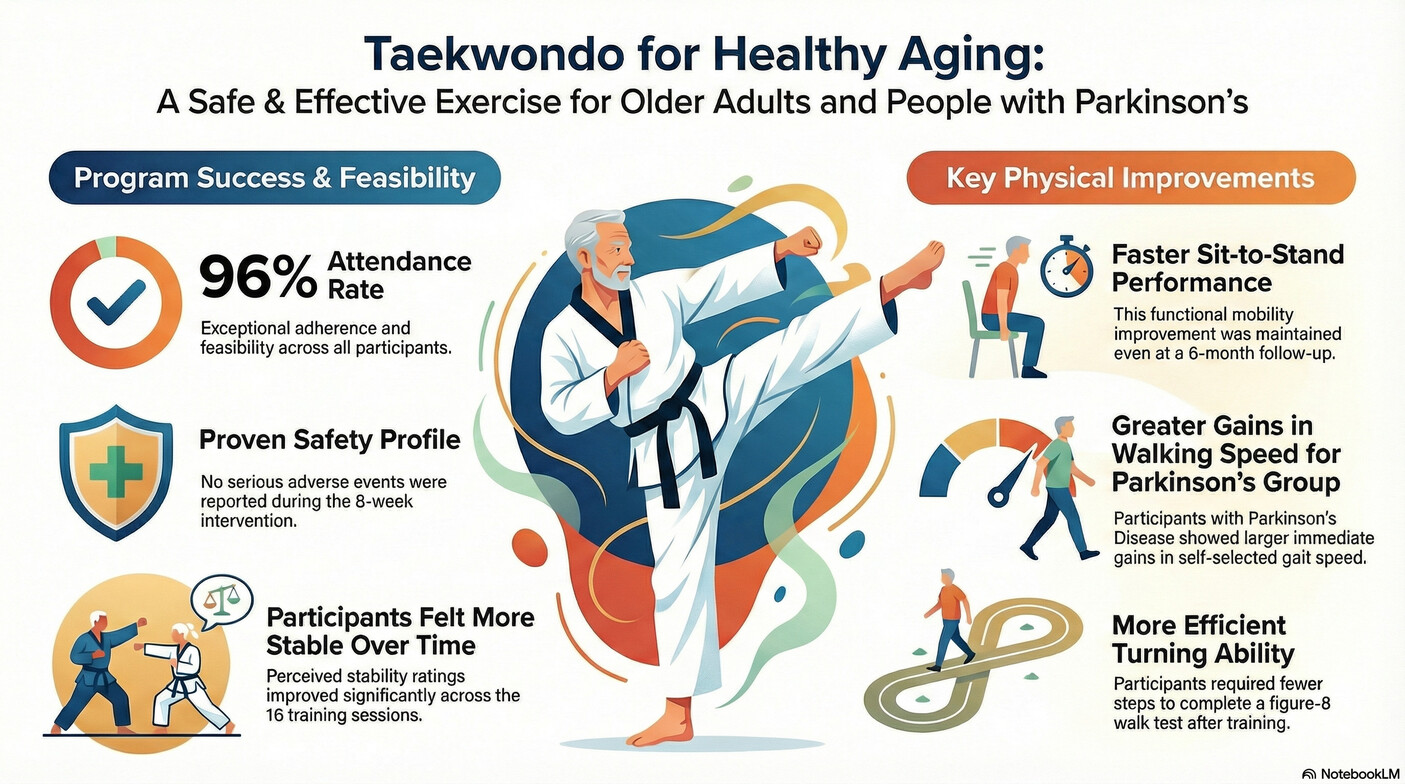
While the program was beneficial for everyone involved, one of the most striking results related to walking speed. After the 8-week program, participants with Parkinson's disease demonstrated greater immediate gains in their self-selected walking speed compared to the other older adult participants.
This is a powerful discovery. Gait and mobility are major challenges in Parkinson's disease, and slowness of movement is a hallmark symptom. In fact, all four participants with Parkinson's exceeded the threshold for a meaningful change in their walking speed, and half of them showed improvements so significant they surpassed the specific criterion used to distinguish real change from simple measurement variability. Finding an engaging community exercise that directly and effectively targets this core issue is a significant step forward.
2. A Workout for the Brain, Not Just the Body
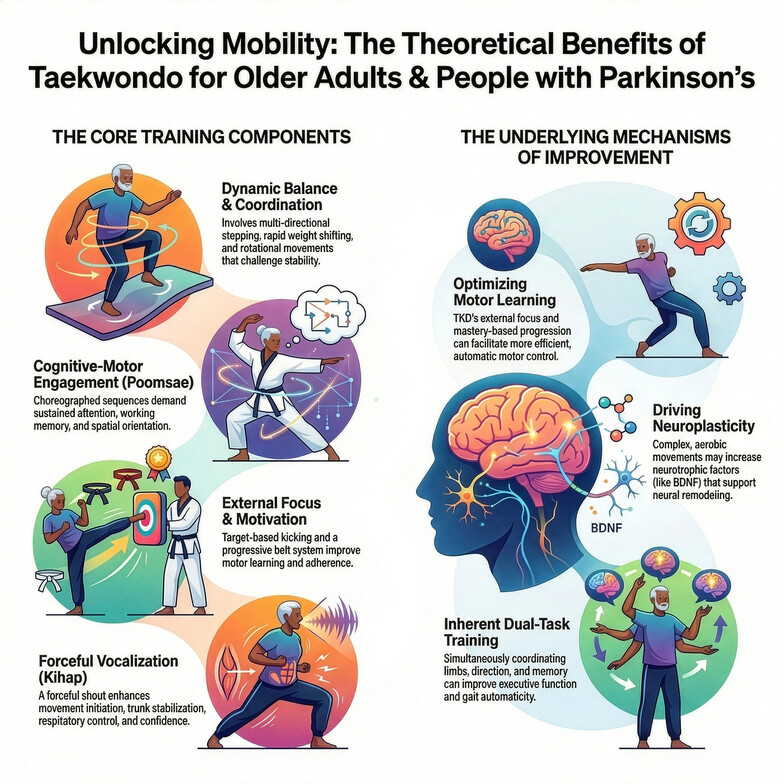
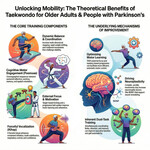
Taekwondo training is not just a physical challenge; it's a profound cognitive workout. A central component of this is the practice of poomsae—choreographed sequences of kicks, blocks, and turns. The study highlights this as a form of "cognitive-motor engagement."
Executing these patterns demands sustained attention, working memory, and spatial orientation. Participants must remember and perform a complex series of movements in a specific order. This mental workout may support executive function and the ability to multitask, skills that can be affected by both aging and Parkinson's disease. In interviews, participants confirmed the significant cognitive demands of learning the new Korean terminology and sequences, framing it as a positive and engaging challenge.
3. The Secret Weapon: A Forceful Shout
A unique element of Taekwondo is the kihap—a forceful shout performed during explosive movements. Far from being just for show, this vocalization may have direct therapeutic benefits.
The study suggests that the kihap can help with movement initiation, trunk stabilization, and even building confidence. In simple terms, the act of a powerful, coordinated shout can help "jump-start" a movement and stabilize the core. This is especially relevant for people with Parkinson's who often experience slowness of movement (bradykinesia) and softness of voice (hypophonia). The kihap provides a strong internal cue that facilitates more powerful and confident action.
4. An Exercise People Actually Stick With
The most effective exercise program is the one people consistently attend. On this front, the Taekwondo program was a remarkable success, with an exceptionally high 96.4% attendance rate over the 8-week period. The study reported no serious adverse events, confirming that the adapted program was not only safe but also highly engaging.
Participants reported a wide range of benefits. One person with longstanding hip discomfort from a joint replacement noted unexpected pain relief while performing certain kicks, describing it as more effective than their previous physical therapy. The structured, motivating nature of the classes was a key factor in their commitment.
The program was highly motivating and provided a structured reason to be more active. Several participants reported that it "got them off the couch" and helped them move more consistently.
Furthermore, the traditional belt progression system, even in a modified form—where instructors affixed colored tapes to belts to signify skill milestones—enhanced participants' sense of achievement and self-efficacy, encouraging them to keep coming back.
5. Feeling Stable Came First
The study revealed a fascinating nuance about balance. Participants began to feel more stable very early in the program. Their self-reported perceived stability improved steadily and significantly across all 16 training sessions. This boost in balance confidence is a crucial benefit in itself, as the fear of falling can be a major barrier to activity.
Interestingly, this feeling came before the objective clinical measurements fully caught up. While participants felt more stable during training, some key balance improvements measured by clinical tests like the Mini-BESTest were "delayed," only becoming statistically significant at the six-month follow-up. This suggests that the program first builds body awareness and confidence, which in turn lays the groundwork for physical improvements that take longer to consolidate.
Conclusion: The Untapped Power of the Local TKD School
This pilot study reveals that Taekwondo is a multidimensional exercise that offers a unique combination of physical, cognitive, and motivational benefits for older adults and people with Parkinson's. It challenges the body and brain simultaneously, all within a structured and highly motivating framework.
Perhaps the most exciting idea to emerge from the research is its scalability. There are about 3,500 Taekwondo studios in the US, and an estimated 44,000 martial arts schools operate across diverse communities, many with empty floor space during daytime hours. These established community hubs represent a vast, untapped resource for public health. By adapting their programs, they could become vital centers for wellness and active aging.
It poses a thought-provoking question for the future: Could the neighborhood martial arts studio be the future of community wellness for aging populations?