Measuring progress after a major health event like a stroke is a fundamental challenge for both patients and clinicians. Objective, reliable data is crucial for understanding what's working, adjusting therapy, and motivating the long, hard journey of rehabilitation. For decades, one of the "gold standard" tools for this has been the Wolf Motor Function Test (WMFT), a comprehensive assessment of upper arm and hand function.
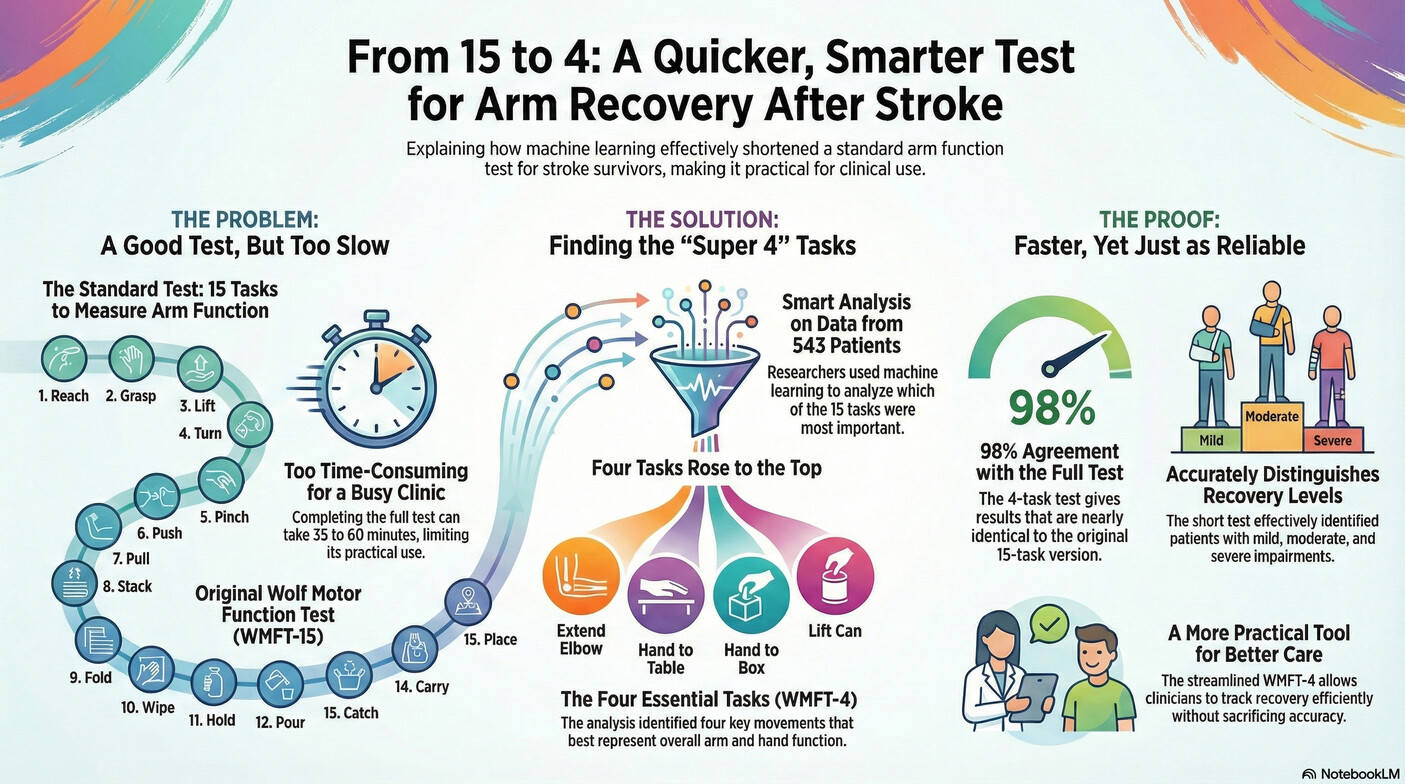
The WMFT provides a detailed picture of a patient's motor abilities, which is why it's so valued in clinical research. However, it has one significant drawback that has limited its widespread use in day-to-day clinical practice: time. A full WMFT can take anywhere from 35 to 60 minutes to administer—a luxury that few busy rehabilitation clinics can afford on a regular basis.
This practical barrier has created a gap between what researchers can measure and what clinicians can feasibly track. But what if there were a way to get the same vital information in a fraction of the time? A recent study leveraged the power of machine learning to analyze a massive dataset of stroke recovery, and the results are a masterclass in efficiency. Researchers discovered a radically shorter, more practical way to assess motor function, boiling a 15-item test down to its four most essential components.
You Can Get 98% of the Information from Just 25% of the Test
Researchers began by pooling data from an initial cohort of 543 stroke survivors, and after a rigorous data-cleaning process, applied their analysis to a final dataset of 432 participants who had completed the full 15-item test. They applied a machine-learning technique known as 'SelectKBest' feature selection, using Random Forest Regressors to identify the smallest possible subset of tasks that could accurately represent the entire test.
The results were stunning. The analysis identified a core set of just four tasks that were so predictive of the total score that they essentially captured the same information. This new, streamlined 4-item version (dubbed the WMFT-4) showed an incredibly strong correlation (r = 0.981) with the original 15-item test.
This finding is significant because it represents a massive gain in efficiency with an almost negligible loss of information. Given that the full test can take up to an hour, boiling it down to just four core tasks represents a potential time saving of over 75%, transforming the assessment from a research luxury into a practical clinical tool. This breakthrough makes a vital assessment far more feasible for routine clinical practice, allowing for more frequent and consistent tracking of recovery.
The Four Moves That Matter Most
The machine learning model didn't just shorten the test; it pinpointed the specific movements that are the most robust indicators of overall function. The four items that make up the new WMFT-4 are:
- Hand to Table (front)
- Hand to Box (front)
- Extend Elbow (side)
- Lift Can
These tasks were not chosen at random. Through a rigorous process of cross-validation and bootstrapping, the algorithm consistently identified these four movements as the most predictive. What's particularly interesting is what wasn't selected. This is a profound insight delivered by the algorithm: the essence of functional recovery isn't necessarily found in the most complex tasks like lifting a paper clip, stacking checkers, or turning a key, but in the consistent and efficient performance of core transport and basic grasp movements.
Recovery Isn't One-Dimensional—It's a Tale of Two Factors
The study went a step further to confirm that the shorter test wasn't just a statistical shortcut but that it maintained the measurement integrity of the original. Using a technique called confirmatory factor analysis, the researchers found that the WMFT measures two distinct but related types of motor control.
- Factor 1: Transport/Non-Manipulation: This component involves tasks primarily focused on moving the arm through space, such as reaching forward to a table or a box.
- Factor 2: Manipulation/Dexterity: This component involves tasks that require handling and interacting with an object, like lifting a can.
Crucially, this two-factor structure was present in both the original 15-item test and the new 4-item version. This confirms that the WMFT-4 isn't just a "lite" version; it preserves the underlying scientific structure of the assessment. This structure also aligns with our understanding of neuroscience, reflecting the brain's separate but coordinated neural pathways responsible for the "reach" (transport) and "grasp" (manipulation) systems.
A Breakthrough for the Real World
The practical implications of the WMFT-4 are enormous. Beyond being dramatically faster, the streamlined test requires less equipment, making it easier to implement in a wider variety of clinical settings where space and resources may be limited.
Most importantly, the study confirmed that the WMFT-4 is just as effective as the full version at its primary job: distinguishing between patients with different levels of ability. The 4-item test was able to clearly and reliably differentiate between patients with mild, moderate, and severe motor impairments. Furthermore, the WMFT-4 demonstrated its validity by correlating strongly with another key metric, the Fugl-Meyer Assessment (FMA-UE), proving it doesn't just mirror the longer test but also aligns with other established measures of impairment. For both clinicians tracking progress and researchers conducting large-scale trials, the WMFT-4 provides a powerful, validated tool that makes collecting high-quality data more efficient than ever before.
Conclusion: Smarter Tools for a Harder Journey
The journey of stroke recovery is incredibly challenging for patients and the professionals who guide them. Progress can be slow, and having accurate, frequent, and practical measurement tools is essential. This research demonstrates how applying modern data science to a large medical dataset can refine a critical assessment, transforming it from a lengthy, research-focused tool into something vastly more practical for real-world care.
By identifying the four movements that truly matter, this study has unlocked a new level of efficiency in rehabilitation. It leaves us with a compelling question: If machine learning can bring this level of clarity and efficiency to stroke rehabilitation, what other long-standing challenges in healthcare are waiting for a similar data-driven reinvention?