Introduction: The Resistance Gap
Stepping into a modern gym often feels like walking into a storm of conflicting dogmas. For decades, the "perfect" routine has been debated with religious fervor: How many sets are optimal? Are free weights the only path to real progress? Does a workout even count if you aren't trembling with exhaustion by the final rep? This pervasive confusion has created a significant "resistance gap" in public health. Current data reveals an alarming reality: approximately 60% of American adults participate in absolutely no muscle-strengthening activities whatsoever.
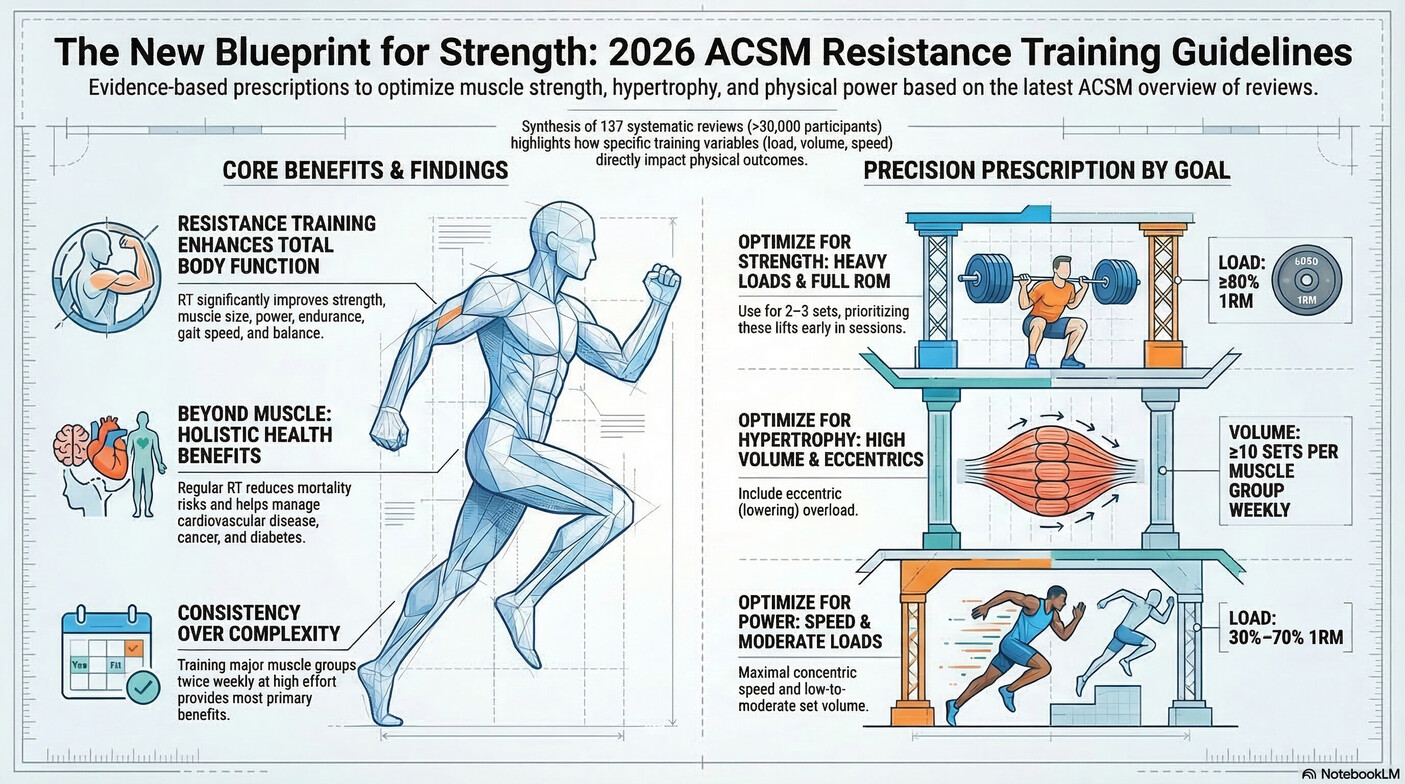
To bridge this gap, the American College of Sports Medicine (ACSM) has released its definitive 2026 Position Stand, "Resistance Training Prescription for Muscle Function, Hypertrophy, and Physical Performance in Healthy Adults." This isn't just another fitness trend; it is a massive scientific undertaking that synthesizes data from 137 systematic reviews involving over 30,000 participants. As an exercise physiologist, I see this as a long-overdue update to the 2009 rules, moving us away from rigid, intimidating prescriptions toward a flexible, evidence-based framework that prioritizes individual participation over gym-floor perfection.
You Don’t Have to Train to Failure
Perhaps the most persistent and damaging myth in strength training is the idea that you must push every set until your muscles physically collapse. The 2026 guidelines provide a refreshing correction: "momentary muscle fatigue" is not a mandatory requirement for significant gains in muscle size (hypertrophy) or strength.
Instead of training to total failure, the research supports the use of "Repetitions in Reserve" (RIR). Practically speaking, this means you should stop a set when you feel you have two or three solid, high-quality repetitions left "in the tank." This shift is a monumental win for long-term adherence and safety. By avoiding the extreme metabolic stress and form breakdown associated with failure, we can significantly reduce injury risk—a critical factor for older adults and beginners who may have previously been deterred by the "no pain, no gain" mentality.
"Completing sets to fatigue (momentary muscular failure) does not enhance gains in strength, hypertrophy, and power, and so is not necessary for benefits to occur."
The "Perfect" Program Matters Less Than You Think
The fitness industry often obsesses over "periodization"—the complex, systematic manipulation of variables like load and volume over weeks or months. While elite athletes may still use linear or undulating periodization to peak for competition, the new science suggests that for the average person, it is not the "magic bullet" it was once thought to be.
The 2026 Position Stand clarifies that periodization is often conflated with basic programming. The data shows that periodized programs are not significantly superior to non-periodized ones as long as progressive overload is present. Progressive overload—the simple act of gradually increasing the challenge to your muscles by adding weight, reps, or intensity over time—remains the non-negotiable driver of progress. This simplifies the barrier to entry: you don't need a complex, multi-month spreadsheet to see results; you just need a commitment to incremental challenge.
Machines vs. Free Weights – The Great Debate Settled
The tribalism between "hardcore" free-weight lifters and machine users has finally been addressed by high-level evidence. The research shows no consistent difference in primary outcomes, such as strength or hypertrophy, based on equipment type. The 2026 update emphasizes that the "best" equipment is the one that fits your personal preference and is most accessible to you.
Furthermore, the guidelines scientifically validate "nontraditional" modes of training, confirming that home-based and portable tools are highly effective for improving both strength and balance. This individualization of equipment choice makes resistance training (RT) viable for everyone, regardless of gym access. Validated modes of training now include:
- Free weights (dumbbells, barbells, kettlebells)
- Weight machines (selectorized or plate-loaded)
- Resistance bands (elastic resistance)
- Body weight (calisthenics)
- Water-based resistance
- Flywheel and eccentric devices
The 10-Set Threshold for Growth
While the guidelines embrace flexibility, they do offer specific, data-backed "doses" for those with clear performance goals. However, the final writer must be careful to distinguish between weekly and per-session requirements:
- For Hypertrophy (Muscle Size): The evidence shows a clear dose-response relationship, with a recommendation of ≥10 sets per muscle group per week to optimize growth.
- For Strength: The focus shifts from total weekly volume to intensity. Strength is best enhanced by performing 2–3 sets per session using heavier loads, specifically ≥80% of your one-repetition maximum (1RM).
By understanding this distinction, you can tailor your week to be high-volume for size or high-intensity for raw power without wasting time on "junk volume" that doesn't serve your specific goal.
Move Fast to Stay Young (Power Training)
The 2026 Position Stand introduces a vital emphasis on "Power RT." This involves performing the concentric phase—the "lifting" part of the movement—with maximal intentional speed. While traditional strength training focuses on slow and controlled movements, Power RT is about explosive intent.
This is arguably the most important takeaway for longevity. Power training has a unique and superior impact on physical function compared to strength alone. It directly improves real-world metrics like gait speed, balance, and the "chair stand" test—the ability to stand up from a seated position without assistance. To train for power, the science recommends using moderate loads (30%–70% of your 1RM) and moving them as fast as possible. The guidelines even highlight Olympic-style weightlifting as a highly effective, albeit more technical, method for developing this functional explosiveness.
The "Minimal Dose" Revolution
Perhaps the most significant paradigm shift in the 2026 update is the transition from "conforming to criteria" to "individualizing for participation." Past interpretations of fitness guidelines led many to believe that a meaningful strength program required a massive time commitment—in some cases, up to 20 hours per week of gym-related activity.
The 2026 science demolishes this "20-hour" perception, proving that substantial health gains can be achieved through "minimal doses" of training. This shift makes the guidelines more accessible to the busiest adults, emphasizing that doing something is infinitely better than doing nothing. The updated stand reinforces that resistance training is not just for the young or the athletic; it is a safe, necessary intervention for humans across the entire lifespan.
"Resistance training is safe for healthy adults of all ages... exercise did not increase the risk of serious adverse events."
Conclusion: Beyond the Barbells
The 2026 ACSM guidelines signal a new era of "Strength for All." By moving away from the rigid "FITT-VP" structures of the past and acknowledging that various paths lead to the same physiological finish line, the science has made health more attainable.
We must remember that the benefits of resistance training extend far beyond aesthetics or "looking good." Engaging in regular strength work is a primary defense against cardiovascular disease, cancer, and diabetes, while also serving as a potent tool for improving sleep and mental health.
As we look toward this new evidence-based future, I leave you with one question: Are you willing to let go of the "perfect" workout and embrace the "minimal dose" that fits your life today? You don’t need a rack of barbells or a 90-minute block of time—you just need to start.